The Intelligence Behind the Haircut
The Poodle is one of the most misunderstood breeds in the dog world — often dismissed as a frivolous "show dog" but consistently ranked among the most intelligent and capable working dogs in existence. Stanley Coren's landmark 1994 book The Intelligence of Dogs — based on surveys of 199 dog obedience judges across the US and Canada — placed the Poodle at #2 overall in "working and obedience intelligence," behind only the Border Collie. This ranking is consistent across all three Poodle varieties (Standard, Miniature, and Toy) — all have the same exceptional cognitive capacity, just in different size packages.
What does this mean in practice? Poodles learn new commands in fewer than 5 repetitions and obey known commands on the first instruction 95% of the time or better. They problem-solve, remember sequences, and generalise learning to new contexts faster than virtually any other breed. The same cognitive horsepower that makes them extraordinary trainees also means they require significantly more mental stimulation than most owners anticipate — a bored Poodle is an inventive, often destructive Poodle.
The Two-Part Formula: Physical and Mental Exercise
The most common mistake Poodle owners make is providing adequate physical exercise while neglecting mental engagement. A Standard Poodle that receives a 45-minute run but no training, problem-solving, or novel stimulation will often still exhibit boredom behaviours — excessive barking, attention-seeking, chewing, or destructive digging — because the cognitive need has not been met. Poodles were originally bred as water retrievers; they are working dogs whose brains are wired for active collaboration with humans.
Research in canine cognitive science shows that mental stimulation can tire dogs as effectively as physical exercise. Fifteen minutes of focused nose work (where the dog searches for hidden treats by scent) or a structured training session requiring concentration produces measurable fatigue and satisfaction in dogs. For Poodle owners, this means training sessions are not optional enrichment — they are as essential as daily walks. The ideal routine includes 2–3 training sessions of 10–15 minutes per day, plus at least one dedicated mental enrichment activity.
How to Train a Poodle: Methods That Work
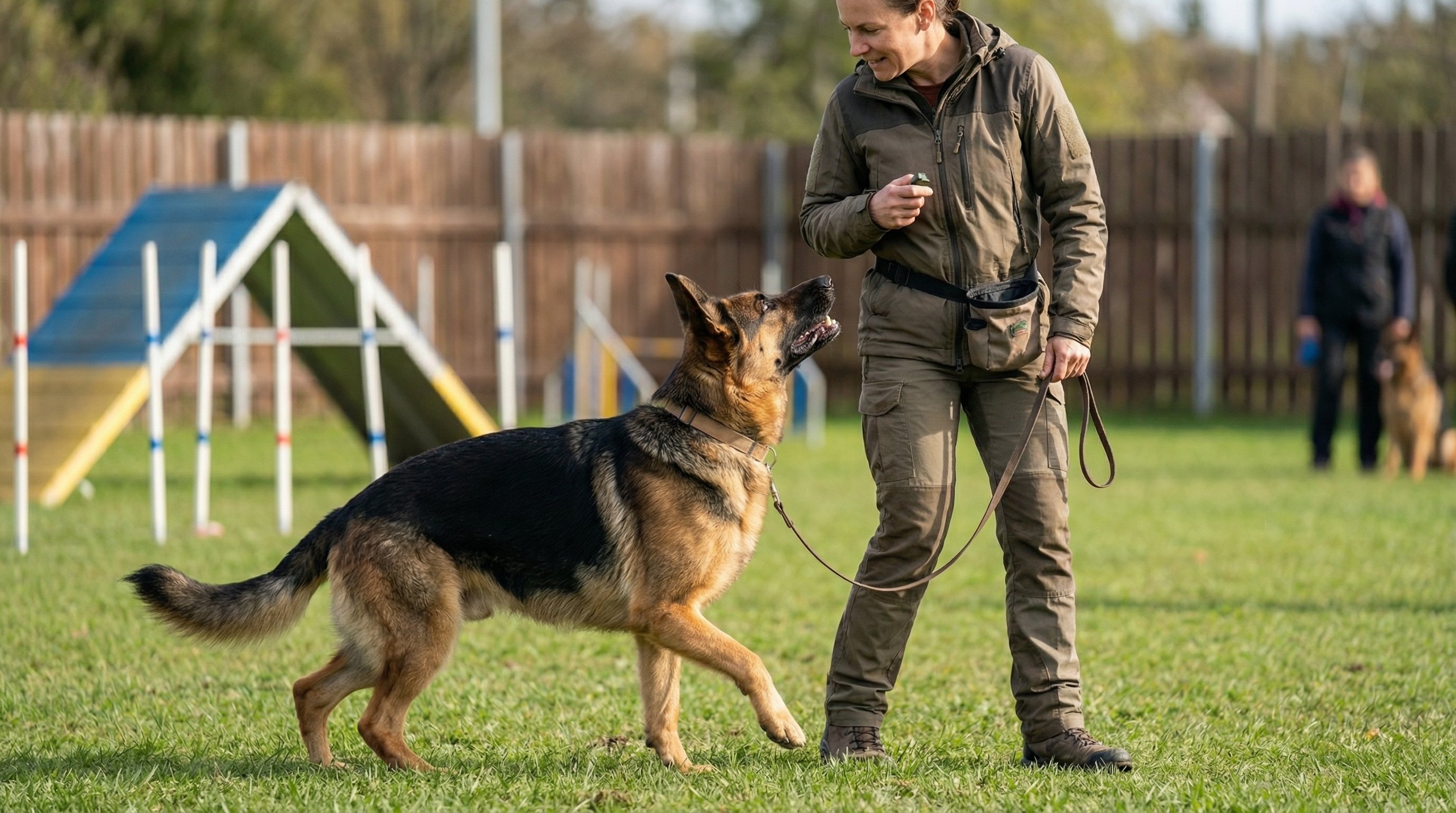
Clicker training is particularly well-suited to Poodles. The clicker (or a verbal marker like "yes!") creates a precise, consistent signal that bridges the gap between the dog's correct behaviour and the delivery of the reward. Because Poodles learn so quickly, the precision of the timing matters enormously — an imprecise marker can accidentally reinforce the wrong behaviour. Begin each training session with 2–3 easy, known behaviours to establish the reward pattern, then introduce new challenges.
Poodles are highly sensitive to handler emotion and tone of voice. Frustration, impatience, or harsh corrections are counter-productive — a Poodle that is corrected sharply often "shuts down" and stops offering behaviours altogether. Always end every session on a success (even if you have to dramatically simplify the task to get there) and use play, praise, and food rewards liberally. Variety is also important: Poodles become bored with repetitive drills. Rotate tricks, change training locations, and introduce new challenges regularly to keep them engaged.
🎯 Best Mental Enrichment Activities for Poodles
- Nose work: Hide small treats around the room or in a snuffle mat — tap into their natural scenting drive
- Trick training: Poodles excel at complex trick chains — spin, bow, roll over, tidy toys into a box
- Agility: Combines physical exercise with rapid decision-making — ideal for Standard and Miniature Poodles
- Object discrimination: Teach the dog to identify and retrieve named objects — Poodles can learn 20+ object names
- Rally obedience: A structured sport that builds heelwork, attention, and handler connection
- Water retrieval: Their historical purpose — Poodles that access water love it and are naturally talented swimmers
Common Behaviour Problems and What They Actually Signal
Poodles are sometimes described as "neurotic" or "high-strung" — but these descriptions almost always describe a dog whose cognitive needs are not being met. Excessive barking in Poodles most commonly signals under-stimulation or separation anxiety (Poodles form very strong attachments to their primary owners). Destructive behaviour — chewing furniture, shredding cushions, digging — is almost always the result of insufficient mental exercise combined with too much unsupervised time.
Separation anxiety is particularly prevalent in Poodles and should be addressed with a systematic desensitisation programme rather than simply leaving the dog alone for increasingly long periods. This involves gradually increasing alone time from seconds to minutes to hours over weeks, using departure cues to create positive associations, and providing enrichment (frozen food puzzles, novel toys) that occupies the dog during absences. If the anxiety is severe — persistent vocalisation, destructive behaviour, or self-harm when alone — consult a certified applied animal behaviourist (CAAB) rather than attempting to manage it alone.
⚠️ Signs Your Poodle Needs More Mental Stimulation
- Excessive or demand barking, especially when you are home
- Obsessive tail chasing, shadow chasing, or light reflection fixation
- Destructive chewing of household items between walks
- Restlessness or inability to settle even after physical exercise
- Attention-seeking behaviour (pawing, nudging, vocalising) throughout the day
Want the Complete Poodle Care Manual?
Full training programmes, enrichment schedules, grooming guides for every clip style, health checklists, and feeding charts — all in one PDF.
Browse All Manuals →