1. What Is BOAS — and Why Does It Affect Almost Every Frenchie?
Brachycephalic Obstructive Airway Syndrome (BOAS) is a collection of anatomical abnormalities that obstruct normal breathing in flat-faced dog breeds. The French Bulldog is one of the most severely affected breeds in the world, and studies published in the journal Veterinary Record estimate that over 70% of Frenchies experience clinically significant breathing restriction. The term "brachycephalic" comes from the Greek for "short head" — these dogs were selectively bred over generations for a flat facial structure that, while endearing, compresses the entire upper airway.
The condition is not a single defect but a syndrome involving up to four distinct anatomical problems occurring simultaneously. Understanding each one is the first step toward recognizing symptoms and taking appropriate action. Many owners assume their Frenchie's snoring and heavy breathing is simply "normal for the breed" — and while it's common, it is never something to ignore without professional assessment.
2. The 4 Anatomical Defects Behind BOAS
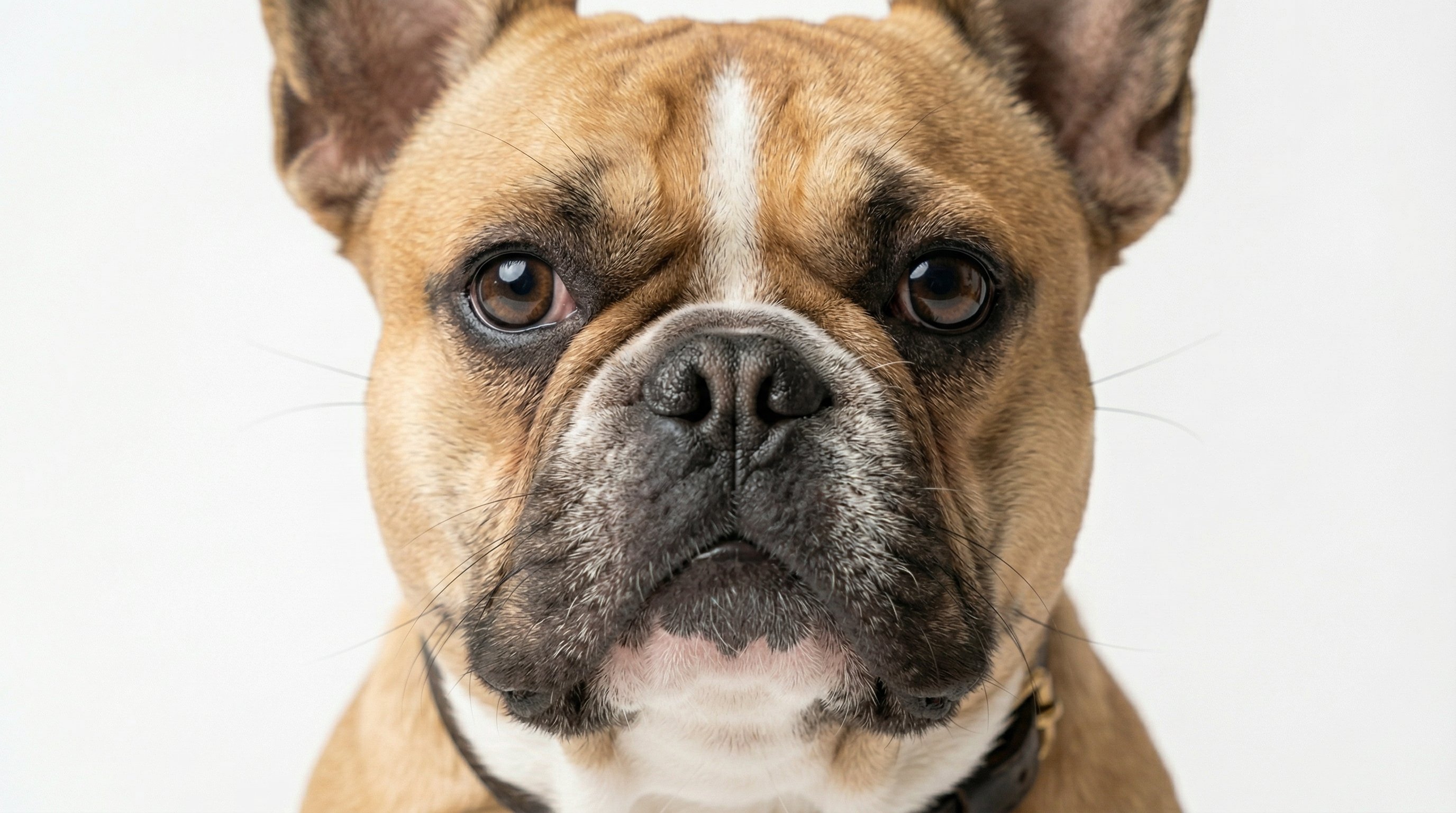
Stenotic nares (narrow nostrils) are the most visible defect. Healthy nostrils should be wide and open, allowing free airflow. In affected dogs, the cartilage is too rigid and the openings too small, forcing the dog to work harder with every breath. You can assess this at home: healthy nares open slightly when the dog inhales; pinched nares barely move. This is the most commonly corrected defect because the surgery is straightforward and highly effective.
Elongated soft palate is perhaps the most clinically significant defect. The soft palate — the soft tissue at the back of the mouth — extends too far into the airway in brachycephalic dogs, partially blocking the entrance to the trachea. This causes snoring, gurgling breathing sounds, and in severe cases, episodes where the dog appears to choke or gag, especially during exercise or excitement.
Hypoplastic trachea (abnormally narrow windpipe) is present in approximately 15–20% of French Bulldogs. Unlike the other defects, this one cannot be surgically corrected — the trachea is simply too small in diameter, restricting maximum airflow. Dogs with this condition have a lifelong reduced exercise tolerance and are at higher risk during anaesthesia.
Everted laryngeal saccules are small pouches inside the larynx that get pulled outward due to chronic negative pressure from the dog struggling to breathe through a restricted airway. This is a secondary defect that develops over time if the primary issues (nares, palate) go uncorrected. These saccules further obstruct the glottis and worsen the breathing restriction progressively with age.
🩺 Signs Your Frenchie May Have Significant BOAS
- Loud snoring, even at rest or while awake
- Noisy breathing — stertor (snoring sound) or stridor (high-pitched wheeze)
- Reluctance to exercise or tiring after just a few minutes of light walking
- Open-mouth breathing during or after mild activity
- Repeated swallowing or retching, especially after drinking
- Sleep apnoea episodes — brief pauses in breathing during sleep
- Cyanotic (bluish-tinged) gums — this is an emergency
3. Heat Stroke: The Invisible Danger Brachycephalic Dogs Face Every Summer
Dogs cool themselves almost entirely through panting — rapid, open-mouth breathing that evaporates moisture from the tongue and airways. For a French Bulldog, this system is severely compromised. Their restricted airway means they can move far less air per breath than a normal-nosed dog, making efficient cooling nearly impossible in warm conditions. Where a Labrador can self-regulate in temperatures up to 25–27°C (77–81°F) with moderate activity, a Frenchie can begin overheating at just 20°C (68°F) during exercise.
Heat stroke in dogs is a true medical emergency with a mortality rate of approximately 50% in severe cases, even with veterinary intervention. The critical temperature threshold is a core body temperature above 41°C (106°F). At this point, cells throughout the body — including the brain, kidneys, and heart — begin to sustain irreversible damage. French Bulldog owners must be vigilant: never walk your Frenchie in the middle of the day during warm months, always carry water, and know the early signs of overheating.
🚨 Heat Stroke Warning Signs — Act Within Minutes
- Excessive, frantic panting that isn't resolving
- Thick, ropy saliva or drooling heavily
- Bright red or pale/bluish gums
- Stumbling, disorientation, or collapse
- Vomiting or diarrhoea
Action: Move to shade immediately, apply room-temperature (NOT ice cold) water to paws, groin, and neck. Fan the dog. Rush to an emergency vet — do not wait to see if they improve.
4. When Is BOAS Surgery Necessary?
Not every Frenchie requires surgery, but every Frenchie should be formally assessed by a vet experienced with brachycephalic breeds — ideally between 12 and 18 months of age when airway anatomy is fully developed. The assessment typically involves a physical exam, sometimes an endoscopic examination of the airway under mild sedation, and a grading of BOAS severity. Many veterinary schools now use a standardised BOAS grading system (0–3) to guide treatment decisions.
Surgery is recommended for dogs graded 2 or 3, or for any dog experiencing exercise intolerance, sleep disturbances, or repeated gagging episodes. The most common procedures are nares widening (stenotic nares resection) and soft palate shortening (staphylectomy or folded flap palatoplasty). When performed by an experienced veterinary surgeon, success rates are excellent — over 80% of dogs show significant and lasting improvement in respiratory function. The procedures are typically performed under the same anaesthetic, and recovery is usually 2–4 weeks.
The key message from veterinary research is: earlier is better. Dogs operated on before age 2 show substantially better long-term outcomes than those operated on later, because secondary changes (everted saccules, tracheal inflammation) have not yet developed. If your vet confirms BOAS grade 2–3, do not delay surgery by years hoping the dog "gets used to it" — the condition worsens progressively without intervention.
5. Daily Management: Exercise, Temperature, and Safety Rules
Regardless of surgical status, all French Bulldogs require specific daily management to keep their airways as clear and comfortable as possible. Exercise should be limited to 20–30 minute walks in cool conditions — early morning or evening only in summer. The widely recommended guideline is never walk a brachycephalic dog when the ambient temperature exceeds 22°C (72°F). Always use a harness rather than a collar: collar pressure on the trachea directly worsens airway restriction and can trigger a breathing crisis.
Never muzzle a French Bulldog unless absolutely necessary for a veterinary procedure — a muzzle closes the mouth and forces the dog to breathe entirely through its already-restricted nostrils, which can cause rapid oxygen deprivation. For travel, keep the car air-conditioned and use a crash-tested crate rather than a seatbelt harness. French Bulldogs are also poor swimmers due to their front-heavy build — always use a dog life jacket near water, and never leave them unsupervised around pools, ponds, or the sea.
✅ Daily BOAS Management Checklist
- Walk only in cool temperatures (below 22°C / 72°F)
- Morning or evening walks only during summer months
- Always use a harness — never a collar on a Frenchie
- Fresh, cool water available at all times; add ice in summer
- Keep living area air-conditioned or well-ventilated
- Never muzzle a brachycephalic dog
- Life jacket required near any body of water
- Annual vet check of breathing quality from age 1
Want the Complete French Bulldog Care Manual?
Everything covered in this article — plus feeding charts, vet schedules, training guides, grooming routines, and full health checklists — all in one professionally written PDF.
Browse All Manuals →